
← Botanical Garden Silimalombu
Made from this plant – available in our shop


Basic Information:
The candlenut is a flowering tree in the spurge family, Euphorbiaceae, also known as candleberry, Indian walnut, kemiri, varnish tree, nuez de la India, buah keras, or kukui nut tree, and Kekuna tree.
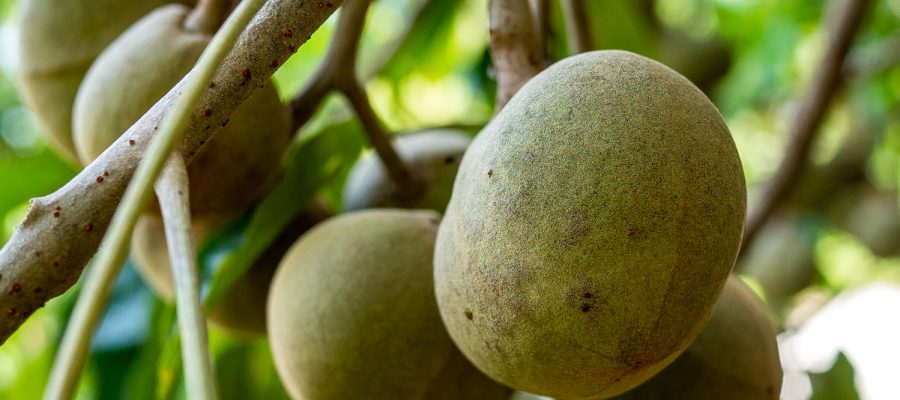
Its native range is impossible to establish precisely because of early spread by humans, and the tree is now distributed throughout the Newand Old World tropics. It grows to a height of 15–25 m (49–82 ft), with wide spreading or pendulous branches. The leaves are pale green, simple, and ovate, or trilobed or rarely five-lobed, with an acute apex, 10–20 cm (3.9–7.9 in) long. The nut is round, 4–6 cm (1.6–2.4 in) in diameter; the seed shell has white, oily, and fleshy kernel that contains a thin embryo surrounded by an endosperm. Its kernel serves as the source of oil, and is covered with a thin layer of secondary seed coat.
The nut is often used cooked in Indonesian and Malaysian cuisine, where it is called kemiri in Indonesian or buah keras in Malay. On the island of Java in Indonesia, it is used to make a thick sauce that is eaten with vegetables and rice. The raw fruit is poisonous.
Modern cultivation is mostly for the oil. In plantations, each tree produces 30–80 kg (66–176 lb) of nuts, and the nuts yield 15 to 20% of their weight in oil. Most of the oil is used locally rather than figuring in international trade.
Candlenut oil has been used for various purposes, such as for the preparation of paints, varnishes, wood polish and linoleum, for illumination, soap manufacture, cosmetics and wood preservation, preservation of fishing nets and in the batik industry. Candlenut oil used in combination with coconut oil has been used for skin and hair treatment.
Nutrition, Traditional Use and Research
The statements below describe nutrition facts, traditional use and published research. They are not health claims for our products.
- The kernel of the candlenut (kemiri) is a traditional ingredient in Indonesian and Malaysian cooking; it must always be cooked, because the raw nut is poisonous.
- In traditional folk practice in some regions, candlenuts have been used for complaints such as diarrhea. These are traditional uses only and have not been confirmed by sufficient scientific evidence.
- Candlenut kernels contain mostly unsaturated fats and some protein and fiber, which can be part of a balanced diet. Studies on tree nuts and cholesterol exist, but results for candlenut itself are lacking.
- Candlenut oil is traditionally used in hair care in Indonesia and in the Pacific, and, together with coconut oil, for skin and hair care. Scientific evidence on effects on hair growth is lacking.
- In the Cook Islands and Tahiti, candlenut oil is traditionally used to make a massage oil. This is a traditional use only.
- Laboratory studies have examined extracts of candlenut for antimicrobial properties. These are test-tube findings and do not show an effect in people.
Fun Facts:
- In Hawaii, fishermen would chew the nuts and spit them on the water to break the surface tension and remove reflections, giving them greater underwater visibility
- In ancient Hawaiʻi, Candlenuts nuts were burned to provide light. The nuts were strung in a row on a palm leaf midrib, lit on one end, and burned one by one every 15 minutes or so. This led to their use as a measure of time
- Candlenut tree wood is used for making canoes, gunwales and seats
- On May 1st, 1959, Candlenut was declared as the state tree of Hawaii due to its numerous uses
- By hawaiians the soot of burned nuts are used as black ink for tattoos
Sources:
https://en.wikipedia.org/wiki/Aleurites_moluccanus
https://www.phcogcommn.org/sites/default/files/10.5530pc.2017.2.12.pdf
How to plant a Candlenut tree?
You just can plant a nut and wait. Or you take from us a seedling or a small tree. If the tree is young he can stay in half shadow, later when he should get huge, he need a lot of sunlight. And also the tree will take a lot of space. He will grow very fast and very high. All the small trees around will give up. Down under of a Candlenut tree it is not possible to grow a lot anymore. Chili is still growing.
The tree can use a lot of compost, but not really needs it. He take out a lot of the minerals of the soil. He is a very hungry tree.
The branches of the tree are not strong. It is dangerous to climb the tree and often also huge branches just break and fall down. Never stay under a huge candlenut tree, when it is windy or even they have a lot of fruits. Newer let a tree grow over your house, or park your car down under.
What you can use all from the tree?
The outer skin of the nuts we use as food for the Black Solder Fly to make worms, which are food for our ducks, chicken and fish. The hard skin of the nuts and the soft inner skin we dry and we use it as fuel for our PizzaSauna oven.
From the nuts we make our cold pressed Kukui Oil. The sediment of the oil we fry and we use it then for cooking and backing.
The leaves could be used for medical treatments. The wood we cut to boards and give them to the lake for at least 3 month to carbonize them. Then it is a wonderful soft lightweight wood, which is perfect to make a Sauna cabin.