

← Botanical Garden Silimalombu
Made from this plant – available in our shop

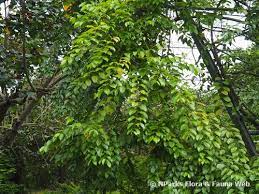
Gambir
Scientific name: Uncaria gambir
Indonesian name: Gambir
Batak name: Gabbir
Basic Information
Uncaria is a genus of flowering plants in the family Rubiaceae. It has about 40 species. Their distribution is pantropical, with most species native to tropical Asia, three from Africa and the Mediterranean and two from the neotropics. They are known colloquially as gambier, cat’s claw or uña de gato. The latter two names are shared with several other plants. The type species for the genus is Uncaria guianensis.
Indonesian Gambier (U. gambir) is a large tropical vine with leaves typical of the genus, being opposite and about 10 cm (3.9 in) long. The South American U. tomentosa is called Uña de Gato.
Gambier extract is used or has been used as a catechu for chewing with areca and betel, for tanning and dyeing, and as herbal medicine. Gambier extract was also used by native people as a medical treatment or prevention of diseases that were believed to be spread by the now obsolete medical theory of miasma.
The Indians invented paan, a gambir paste, that was believed to help prevent miasma; it was considered as the first antimiasmatic application. The gambir tree is found in Southern India and Sri Lanka.
Source: Wikipedia
Nutrition, Traditional Use and Research
The statements below describe nutrition facts, traditional use and published research. They are not health claims for our products.
- Gambir (Uncaria gambir) is a climbing shrub of Southeast Asia. An extract made from its leaves and twigs, called gambir, is traditionally used for chewing together with betel leaf and areca nut (please see our health note on betel nut), for tanning leather, as a natural red-brown dye for textiles and batik, and in traditional herbal practice.
- Gambir leaves contain catechins, which show antioxidant activity in laboratory tests. Laboratory studies have also examined gambir extracts for antibacterial properties. These are test-tube findings and do not show an effect in people.
- In traditional folk practice, gambir tea from leaves and twigs is used for digestive complaints, and gambir extract is applied to the mouth or the skin, or used in traditional face masks. These are traditional uses only. They have not been confirmed by sufficient scientific evidence, and they are not a replacement for medical care.
- A scientific publication on gambir and stomach inflammation (gastritis) is linked below. Findings from laboratory and animal studies do not establish that gambir prevents or treats any condition.
Scientific research about how Gambir is working with Gastritis:
https://www.ncbi.nlm.nih.gov/pmc/articles/PMC6953953/