
The Second Layer
Humanity has sealed an area of the Earth larger than entire countries — roofs, roads, squares, parking lots. Today those surfaces only heat up. We want every one of them to grow a second layer: food or solar energy, above the concrete.
Every sealed surface on Earth gets a second layer — for food or for energy.
The largest unused resource on the planet is right above our heads
We clear forests for farmland and solar parks — while millions of hectares sit idle in the middle of our cities: already built, already owned, already connected to the grid. Every flat roof is an unplanted field. Every parking lot is an unbuilt power plant. Every road is a heat trap that makes our cities unbearable.
The sealed surfaces of the world catch more solar energy every day than humanity consumes — and let it burn away. They sit exactly where people live, where energy is needed, where food is eaten. No transport routes, no new land use, no conflict with nature: every second layer takes pressure off a forest or a field somewhere else.
Use it or pay for it
No bans, no bureaucracy of prohibition — one simple rule enforced by a levy that makes idle concrete expensive and living surfaces profitable.
A levy on idle sealed surfaces
Every unused sealed surface is taxed. Year one is almost symbolic. Then the rate climbs fast — until using the surface is cheaper than paying for it.
Owners use it — or pass it on
Nobody has to garden or install panels themselves. Owners can hand their surface to neighbours, cooperatives, schools, energy companies, start-ups. The levy creates a market.
A wave of innovation
Cities pay residents to tend hanging gardens above the streets. Highway operators roof their lanes with solar and sell the power to the cars below. Everyone can join — everyone can earn.
Cooler cities, local food, clean energy — from surfaces we already have
It cools the cities
Greened and shaded surfaces measurably lower urban temperatures. Heat waves lose their deadliest stage: sun-baked asphalt.
It feeds people where they live
Climbing plants — pumpkin, passion fruit, beans, grapes — need little soil and give a lot. Food grown above your own street needs no truck, no cold chain, no packaging.
It produces energy without new land
The world’s sealed surfaces are large enough to supply a major share of global electricity from the sun — without felling a single tree.
It gives people their agency back
Climate action stops being something you suffer or pay for. It becomes something you do — with your own hands, at your own door, with a harvest you can see.
It already works — here at Silimalombu
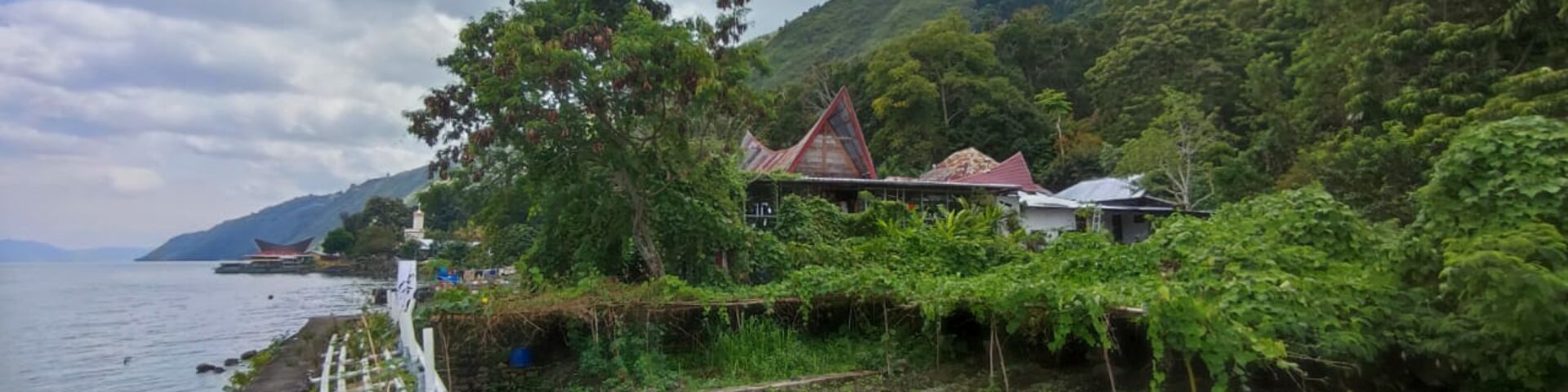
At Ecovillage Silimalombu on Samosir Island, a whole house has disappeared under passion fruit vines. The footpaths run beneath a canopy of pumpkins. A solar roof delivers 20,000 watts. Cooling, food and energy — on surfaces that anywhere else would be bare concrete.
It works. Today. Without high technology, without subsidies, without miracles.
The building blocks exist — the world just hasn’t joined them yet
France
Large parking lots must be covered with solar canopies by law.
Basel & Hamburg
Green roofs are mandatory on new flat-roofed buildings.
South Korea
A solar-roofed bicycle highway runs down the middle of a motorway.
One resolution, three commitments
We call on the United Nations to pass a resolution inviting every member state to act:
- Recognise the principle that sealing a surface creates a responsibility — the responsibility to make it productive for food or energy.
- Introduce a rising levy on unused sealed surfaces, with the revenue flowing into greening and solarising those very surfaces.
- Remove the legal barriers so owners can safely and simply hand their surfaces to others to cultivate — from a neighbour to a cooperative.
The surfaces are there. The sun is already shining on them.
Start on your own roof or wall, and show the world your second layer. Every greened surface is an argument nobody can refute.